
The Unforgivable Sin
The entertainment industry forgave Boy George’s violent conviction. It could not forgive his song about Jews.

In January 2009, a judge at Snaresbrook Crown Court sentenced George O’Dowd to fifteen months in prison. The world knew him as Boy George. A jury had convicted him of falsely imprisoning Audun Carlsen, a Norwegian model he handcuffed to a wall fixture in his London flat. Carlsen told the court he wrenched the fixture loose to get free, then ran into the street in his underwear while the singer swung a metal chain at him. The judge called the act premeditated, callous and humiliating. Carlsen has said he was diagnosed with PTSD and spent a decade in therapy.
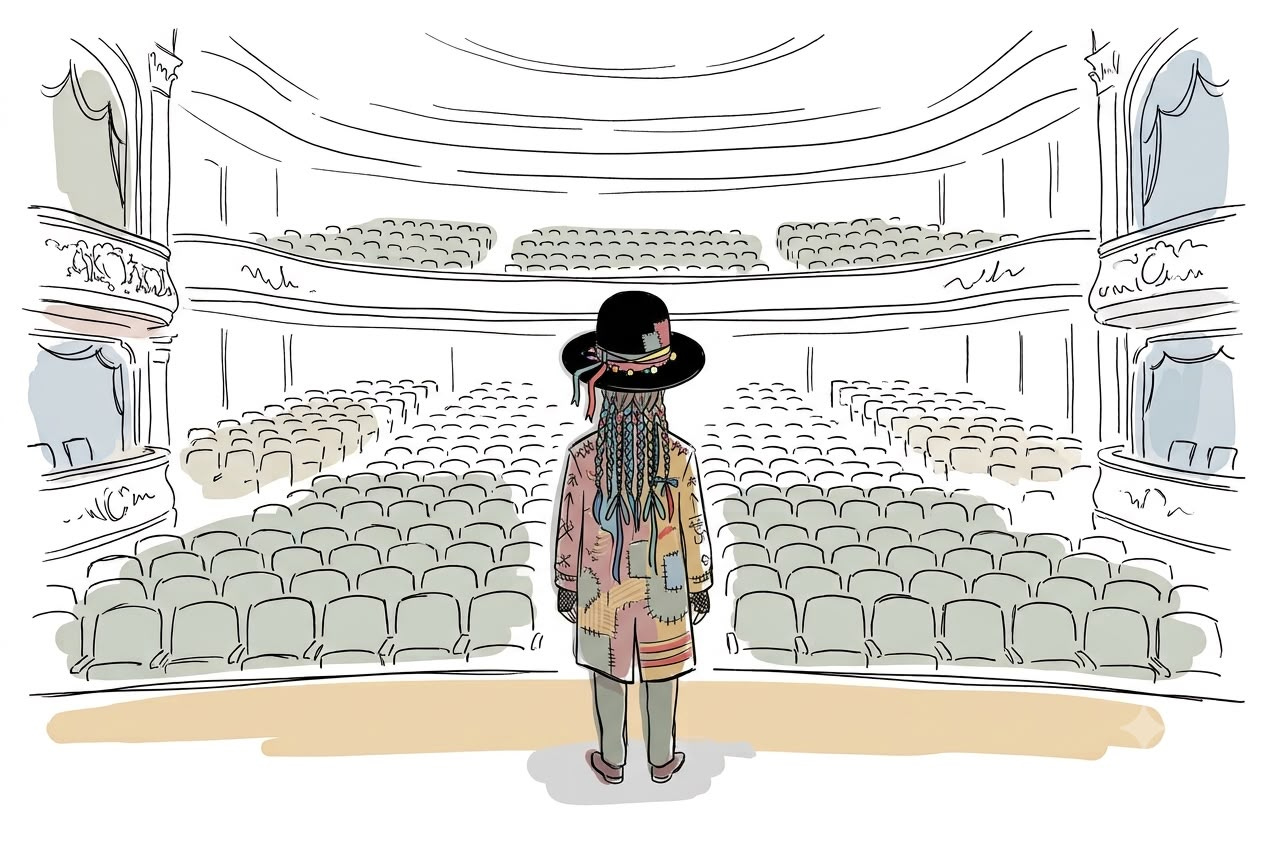
George served four months. Then British entertainment welcomed him home. He coached on The Voice UK for the BBC, then The Voice Australia. In 2022 he joined I’m a Celebrity, and when a few viewers objected, ITV issued a statement about spent convictions and kept filming. In 2024 he starred in Moulin Rouge on Broadway. This summer he was cast as King Herod in Jesus Christ Superstar at the London Palladium, sharing the role with Richard Armitage and Julian Clary. Opening night was set for August 3.
He never made it to the stage.
On July 26, he posted a song called “We Will Dance Again,” captioned with a single word: Shalom. The title is the phrase survivors of the Nova festival massacre made into a vow. The lyrics reject the word genocide and call the war what he believes it is: a war. They describe what happened to young women at Nova on October 7. They accuse fellow musicians of waving flags and following the herd, and they close with a plain declaration that he stands with the Jews.
The backlash took hours. Within four days, his manager announced he would no longer appear at the Palladium. The statement praised George for standing by his “personal convictions” and never named them. It did not have to. Everyone reading it knew which convictions were meant, because nothing else about the man had ever cost him a job.
His critics deserve one concession. George makes a poor martyr. His record is real, and his victim is real, and I hold no brief for him. The song itself is an awkward piece of work. He admitted he made it with AI, and joked that he would have struggled to write it with a human. If your complaint is that a pop icon outsourced his conscience to software, that complaint has merit. The sequence tells the truth anyway. Nobody organized to remove him from a stage over synthetic vocals. The campaign began when the words became clear, and the words were about Jews.
Here is what the timeline establishes, and it should unsettle you far more than one aging pop star’s career. A violent conviction was survivable. Pleading guilty to filing a false police report in New York, where officers found cocaine in his apartment, was survivable. Four decades of feuds and provocations were survivable. The industry priced all of it, paid it, and booked him again and again. One song of solidarity with Jews exceeded the budget in four days.
If George were the only data point, you could argue his history finally caught up with him. He is one of two.
In June, Gwyneth Paltrow appeared in a commercial for 51 Park, a luxury residential tower in Herzliya, a coastal city north of Tel Aviv. The ad was filmed in New York, and it contains no politics of any kind. The tower stands on undisputed ground in a wealthy beach town. She wakes up, goes for a run, and tells her driver the building she lives in is in Herzliya. For this, an influencer with 3.4 million followers renamed her “Gwynicide Paltrow,” and her Instagram flooded with accusations of complicity in genocide over an ad she never even posted herself. One celebrity asked publicly whether she was a genuinely nasty person or just stupid, and concluded she needed to be cancelled.
Her actual record is worth reviewing. Paltrow spent two decades selling pseudoscience through Goop, including a settlement with California prosecutors over unsupported health claims for jade eggs. She sat through a televised ski-crash trial. She has delivered enough out-of-touch moments to sustain a small meme economy. Through it all, the public response was mockery: parodies and jokes about kale. The first time in her adult life that she faced organized hatred, actual venom, demands for her erasure, was the moment she said the name of an Israeli city out loud.
Two celebrities, opposite profiles. One carries a conviction for chaining a man to a wall. The other’s worst offense is a rock crystal. One made an explicit political statement. The other made none at all. Both discovered the same tripwire in the same summer, and it had nothing to do with harm or guilt. Proximity to Jews was sufficient.
That is the finding, and it required no leaked memo to uncover. The enforcement mechanism published its own price list in real time. Assault, drugs, deception and quackery all sit in the forgivable column. Standing with Jews, or standing near them, sits alone in the other one.
The same runs in the opposite direction. In June, Prada named the rapper Saint Levant its global ambassador and pushed a campaign video to 33 million followers in which he wore a pendant of the land from the river to the sea with Israel removed from the outline. This is the same performer who stood on a stage in November 2024, days after mobs hunted Israeli soccer fans through the streets of Amsterdam, and thanked the attackers for taking care of business. A luxury house reviewed that record and saw the face of a brand. Then in November, Glamour crowned Ms. Rachel a Woman of the Year for her Gaza advocacy, and the room rose to its feet as she described the war with the exact word Boy George was pushed off a stage for refusing. Weeks earlier she had become a global ambassador for the Palestine Children’s Relief Fund. Her care for children in Gaza pushed her to such extreme that she repeats extreme anti-Jewish rhetoric in the name of Christianity. The asymmetry is still the story. One vocabulary earns ovations and ambassadorships. The other vocabulary earns an unlit theater.
I have documented this pattern from other angles, from the DJ hounded out of her own concert in France for being Jewish to the coordinated networks that manufacture outrage on demand. Boy George and Gwyneth Paltrow are useful because they remove every excuse. You cannot claim this is about accountability when the industry forgave the chain and punished the song.
September will bring the dates George was supposed to perform, and other artists will keep making the same calculation he made, weighing solidarity against a career. The evidence of what that costs is public now, and the score is easy to keep: which people face campaigns, and which never do, whatever they have done.
If this reached you, share it with someone who still believes cancellation follows wrongdoing. And if you want this work to continue, subscribe. I intend to keep the record either way.
Thank you for keeping score. My anger and despair is made worse by only being able to share with other members of the ‘choir.’ Even Christian friends who are on our side are afraid to share. We need Rabbis and Pastors to speak to their congregations.
Thank you for continuing to keep track and connecting the dots that create the same picture. Have a peaceful Shabbat. Shabbat Shalom.