

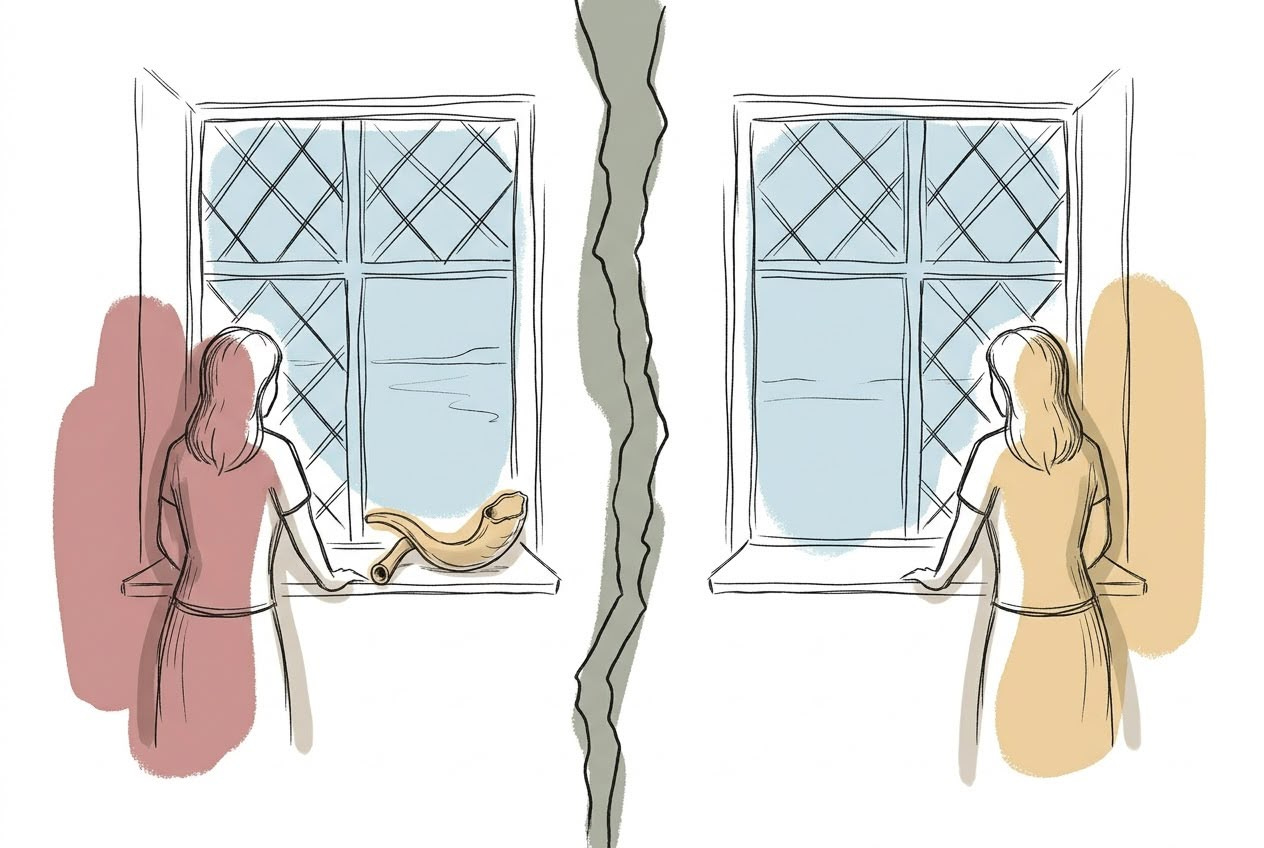
Tonight is the first night of Rosh Hashanah, the Jewish New Year. Normally, the first day is marked with the sound of the shofar. But because the first day falls on Shabbat, the first shofar will not sound until Sunday. Saturday will be silent.
The last time this happened was September 16, 2023, only three weeks before the October 7 massacres.
In the Talmud, Rabbi Yitzhak taught that any year in which the shofar is not sounded at its beginning will have the alarm sounded at its end, because the Satan was not confused by the shofar and was free to bring his accusations against the Jewish people in the heavenly court.
The commentators are careful here. Rashi explains that Rabbi Yitzhak meant a year in which something prevented the blowing. Rosh Hashanah falling on Shabbat is the calendar, and our keeping Shabbat is no mistake.
Still, the last time the first day of the new year fell on Shabbat was, for many of us, the worst year of our lives. It began with a massacre so horrific that many of us are still haunted by the images, and the surge of antisemitism that followed it has not stopped.
If we’re so worried about it, then why not just blow the shofar? Well, the laws around that are even clearer than the superstitions around not blowing it. Everyone is obligated to hear the shofar, but not everyone knows how to blow one. It’s harder than you think; take my word for it.
So a person who couldn’t blow his own shofar would take it to someone who could. On Shabbat, carrying anything from your house into the street is not allowed. So they banned the blowing for everyone, experts included.
In the Temple they blew it on Shabbat anyway. But the Temple is long destroyed, so our only option is to let the day remain silent.
The shofar is a ram’s horn because of the binding of Isaac. After Isaac was bound and laid on the altar, Abraham looked up and saw a ram caught in a thicket, and he sacrificed it instead of his son. The Talmud says God asks us to blow a ram’s horn so that He will remember that binding and count it as though we had bound ourselves.
So which is it? Do we blow the shofar to confuse the Satan, or to show God we are loyal to the promise our ancestors made? The Talmud is made up of rabbis arguing over exactly these questions, and we are allowed to pick the interpretation that speaks to us.
The Torah refers to the day as Yom Teruah. It never defines the ancient Hebrew word teruah, but the Aramaic translation is “yevava,” which means sobbing. The Talmud went looking for someone sobbing in the Bible, found only one, and ruled that her cry is the sound the shofar has to make.
The sobbing that we replicate is not that of our own people, but of Sisera’s mother. In the Song of Deborah, she is a character not even given a name, the mother of a Canaanite general whose 900 iron chariots had oppressed the Israelites for 20 years.
Sisera was defeated by the Israelites and killed by a woman, Yael, who drove a tent peg through his temple while he slept. The song ends at his mother’s window. She notices that his chariot has not returned, and she wails. Tradition counts her cries at 100, and that is why we blow the shofar 100 times, to imitate her grief.
A midrash suggests it is Sarah’s wails, when she learned that her son Isaac had been taken up the mountain. Some say it is both.
So why is it Sisera’s mother’s wails that we replicate on Rosh Hashanah? She is the mother of an enemy of Israel, and yet her tears are placed on the same level as our matriarch Sarah’s. It’s because a mother’s grief sounds the same on every side of a war.
And that brings us back to the last time Rosh Hashanah landed on a Shabbat.
The shofar will not sound on the first day of this new year. But since the October 7 massacres, there has been so much wailing from mothers who have lost their children that we don’t need the shofar to remind us. Rather than worry that we are due for another calamity, I think we need to focus on the tears that still haven’t dried and the wailing that hasn’t stopped. A new year stands before us, and this year we don’t need an imitation of the grief that the innocents of this region, Israeli and Palestinian, have felt.
I will go with Rashi. The silence tomorrow is the calendar doing what it does, and keeping Shabbat is no mistake. It’s the interpretation that lets us open the year with hope, and we need a good year.
Shana Tova to you and your loved ones.
I was reminded reading this of Nicholas Wolterstorff writing after the death of his 25-year-old son:
“I shall look at the world through tears. Perhaps I shall see things that dry-eyed I could not see.”
Shana Tova to you and your loved ones too Hen. With warmth, gratitude and hope. Debbie
Hen,
Thank you for your courage to write and keep track of the world during these difficult times. To speak your truth. May we ‘blow the shofar’ for the many wailing mothers out there. Rachel Goldberg -Polin comes to my mind tonight . “When we see you again” was the most wrenching and profound book about a mother’s grief I have ever read. Praying that she is held in light and in blessings this New Year.
Shana Tova to you.