
The Devil Wears Valentino
The gown, the eulogy, and the most dangerous woman in Qatar.

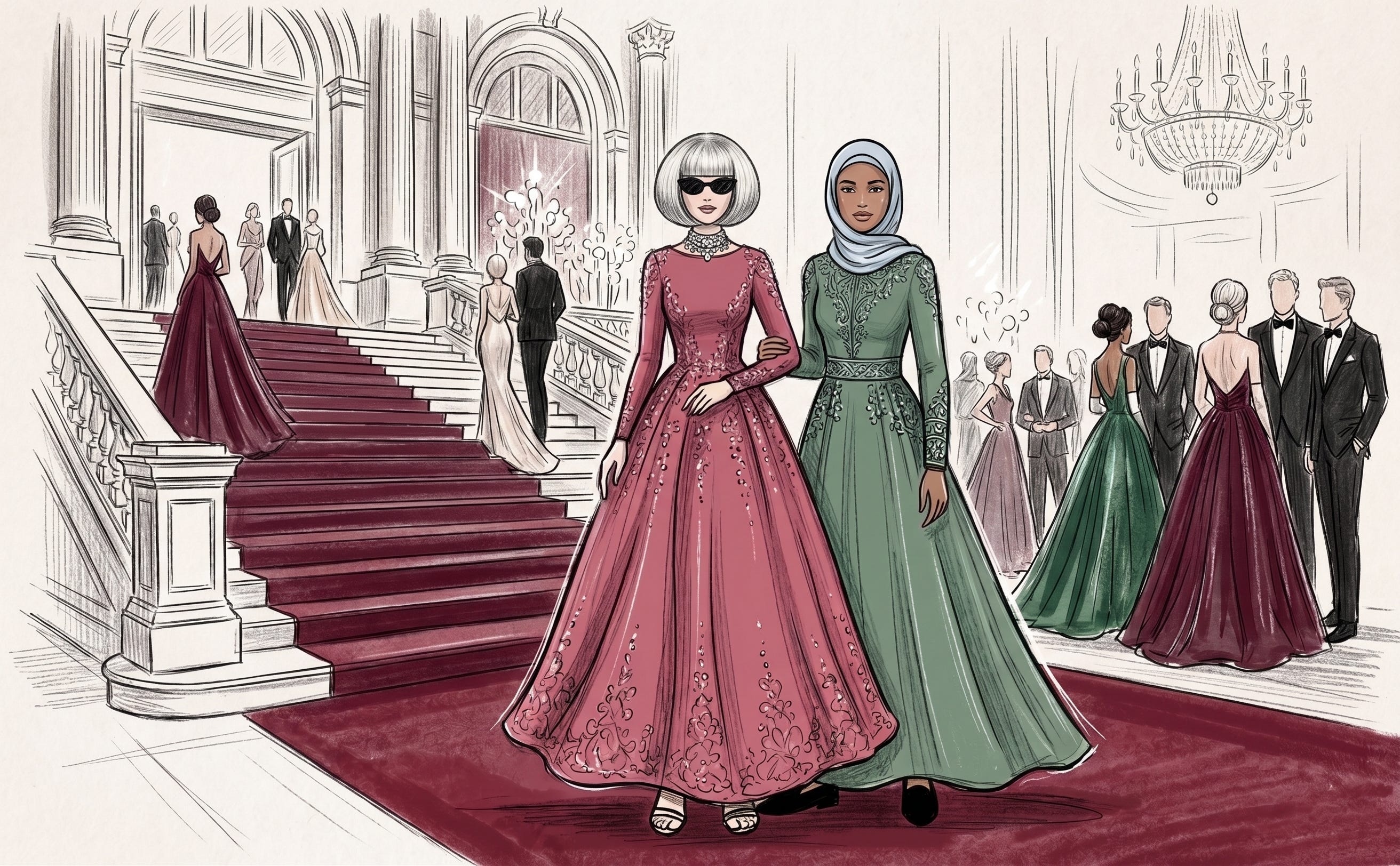
In November 2025, Anna Wintour sat beside Sheikha Moza bint Nasser at the Fashion Trust Arabia awards in Doha. The photographs were exquisite. They always are. Moza has spent thirty years perfecting the image: haute couture adapted to modest dress, a museum gala glow that makes her indistinguishable from any Western first lady with a foundation and a cause.
Thirteen months before that dinner, on October 18, 2024, the same woman posted a eulogy for Yahya Sinwar. The architect of October 7. She wrote that his name means the one who lives, that “he will live on and they will be gone.” They. The country whose civilians his men burned in their homes.
Vogue’s editorial leadership read that post, or could have, and sat down at her table anyway.
I have to be careful now, because the case for Qatar is always made in reasonable tones and I should give it an honest hearing. Qatari mediation helped bring hostages home, in 2023 and again in the deal that returned the last of them in January 2026. Qatari money kept the lights on in Gaza when nobody else would pay. And the sharpest version of the defense is one Israelis have to swallow whole: our own governments approved the cash. The suitcases crossed with Jerusalem’s blessing, thirty million dollars a month, because the people running Israel’s security establishment, with the prime minister’s public approval, treated a funded Hamas as a quiet Hamas.
Every word of that is true. And every word of it is the crime.
Start with what the money bought. Qatar moved more than 1.8 billion dollars into Hamas-run Gaza over the years. The official story, repeated by Doha for a decade, was that the funds paid salaries and fuel for the poorest families, audited and clean. Then Israeli soldiers started pulling documents out of the ruins. In one, from 2019, Ismail Haniyeh described Qatar as the main artery of Hamas fundraising. In another, from 2021, Haniyeh wrote to Sinwar that the emir had "agreed in principle to supply the resistance discreetly," with the first millions already raised. The Shin Bet's conclusion, as these documents surfaced, was that the Qatari pipeline is what allowed Hamas to build the force that crossed the fence on October 7. The tunnels under Gaza were dug by men whose paychecks cleared. The Nukhba trained for years on a budget that never ran dry.
So the question that matters is who sold the world the clean version. Who made a terror sponsorship look like philanthropy.
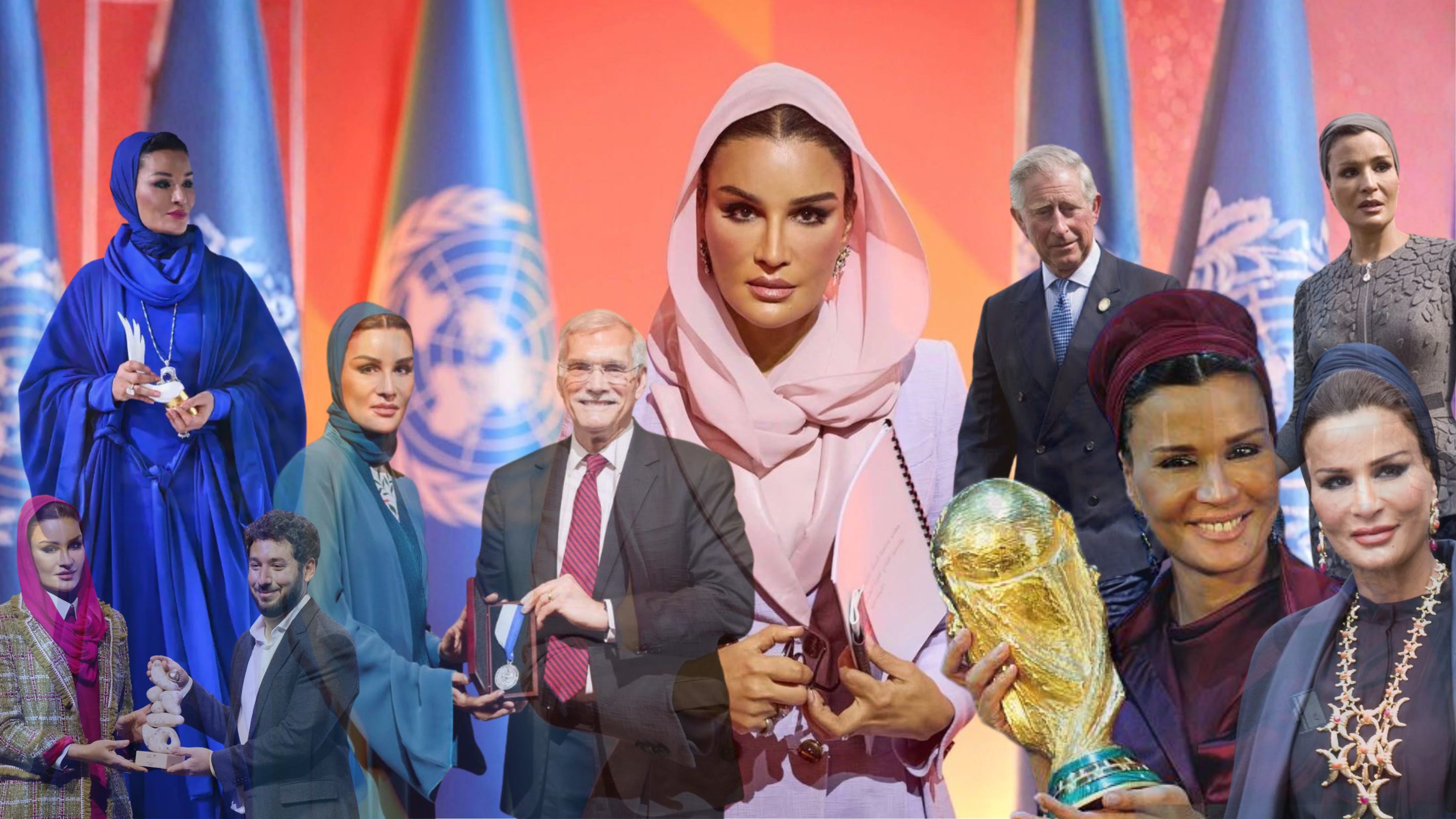
Moza was there from the start. On October 23, 2012, she crossed into Gaza at her husband's side, the first visit by any head of state to Hamas territory, greeted by Haniyeh and an honor guard while the pledge on the table grew from 250 million dollars to 400 million in the course of a single day. She stood in the photographs. She was the photographs. A regime writing checks to a terror organization is a scandal. A glamorous royal couple inaugurating reconstruction projects is a humanitarian story.
And 2012 was a busy year for the family in other ways: its money bought the house of Valentino outright and took a stake in Louis Vuitton's parent company, while Harrods had been theirs since 2010. She wears what the regime owns.
Her formal portfolio tells the same story in a softer font. She co-founded and chairs the Qatar Foundation, which built Education City and brought Georgetown, Northwestern, and Cornell to Doha. Under that same foundation, in 2008, she established a research center named in honor of Yusuf al-Qaradawi, the Muslim Brotherhood’s spiritual leader, the cleric who blessed suicide bombings on Al Jazeera for years. The foundation paid Tariq Ramadan, grandson of the Brotherhood’s founder, 35,000 euros a month as a consultant. In 2009 she registered as a foreign agent in the United States to run a campus campaign, with Justice Department filings describing goals like recruiting student leaders at American universities. The campuses were the delivery system.
After October 7 she did not go quiet. On October 8, while the bodies in the Negev were still being counted, she posted a lament for Palestine to her more than a million followers. Weeks later she resigned her UNESCO envoy post over Gaza’s schools without once mentioning what had been done inside Israeli ones. The following year she told a summit that the world had failed the children of Gaza, and she was right, and she has never explained her family’s role in arming the men who hid beneath them.
The systemic part is bigger than one woman’s Instagram. Qatar built a business model. The pitch to the West runs like this: someone has to talk to the groups you cannot touch, and we volunteer. We will fund them and house them, and the channel stays warm. The groups become dependent on Doha, and the West becomes dependent on Doha’s access. Doha collects from both sides of the table. Mediation is the service. Terror is the inventory. Moza’s job, performed brilliantly for three decades, was to make the inventory invisible: to be the philanthropist at the gala, the reason a European official could shake a Qatari hand without checking what it had signed.
The operation is also generational. Moza’s daughter, Sheikha Al-Mayassa, runs the culture side of the family machine, chairing Qatar Museums and the Doha Film Institute, and Doha has backed the film career of director Mira Nair since at least 2009, staging her Monsoon Wedding musical as part of the World Cup festivities. Nair’s son is Zohran Mamdani. During his run for mayor of New York, Al-Mayassa boosted his candidacy on Instagram, promoting favorable polls and cheering a campaign video of him embracing his mother. Mamdani has not commented publicly on the support, and nothing suggests he sought it. That is what makes it worth noticing. Doha invests early in the people it likes, and the dividends surface decades later in places nobody thought to watch.
Israel bought the pitch too, and this is the part my own country has barely begun to face. Israeli media reported that the Shin Bet’s chief warned Netanyahu in 2019 that Qatari cash was reaching the military wing, that Military Intelligence followed in 2020 with an assessment that Mohammed Deif was siphoning millions a month, and that the payments continued anyway. The prime minister’s office denies any such warning ever reached his desk. What no one denies is the ending: reporting this January revealed that weeks before October 7, Israeli officials sat in a Jerusalem hotel and asked Qatar to increase the transfers. The security establishment chose the theory that a paid enemy is a patient one, and the people selling that theory sat in Doha. Qatar funded more than October 7. It purchased the ten quiet years in which the attack was built, and it paid for them partly with our consent.
Sinwar is dead. The war has ended, the hostages are home, and Moza is back at the museum galas, collecting a President’s Medal from Georgetown in the spring of 2025, seated beside Wintour by winter. The institutions honoring her know what the record says, and they take the money anyway. Every university that banks Qatar Foundation grants, and every editor who accepts the seat next to her, is renting out the legitimacy she has been buying since Gaza, 2012.
That legitimacy is the one asset we can actually reach, and I know how the objection goes: the President of the United States accepted a $400 million jumbo jet from Doha, so who exactly is withholding anything? True. Governments will keep needing Qatar's phone lines, and some will keep taking its planes. Notice, though, that the number repeats: $400 million pledged in Gaza in 2012, $400 million parked on an American tarmac. The price of legitimacy is apparently stable. Washington is beyond the reach of an essay. Georgetown is not, because universities answer to donors and alumni, and editors answer to readers. A gala confers glamour only if the guests agree to look away. The next institution that honors her should be made to read the eulogy first, out loud, in the room. The woman who mourned Sinwar in public should at least be admired in public by people willing to say what they are admiring.
Qatar owns the American educational system & Americans, in turn, wear their blindfold as a badge of courage.
Exposing the template of soft (evil) power in a soft voice … brilliant essay.