
Giant
Roald Dahl swore he was only anti-Israel. The play watches that fall apart, and so did I.

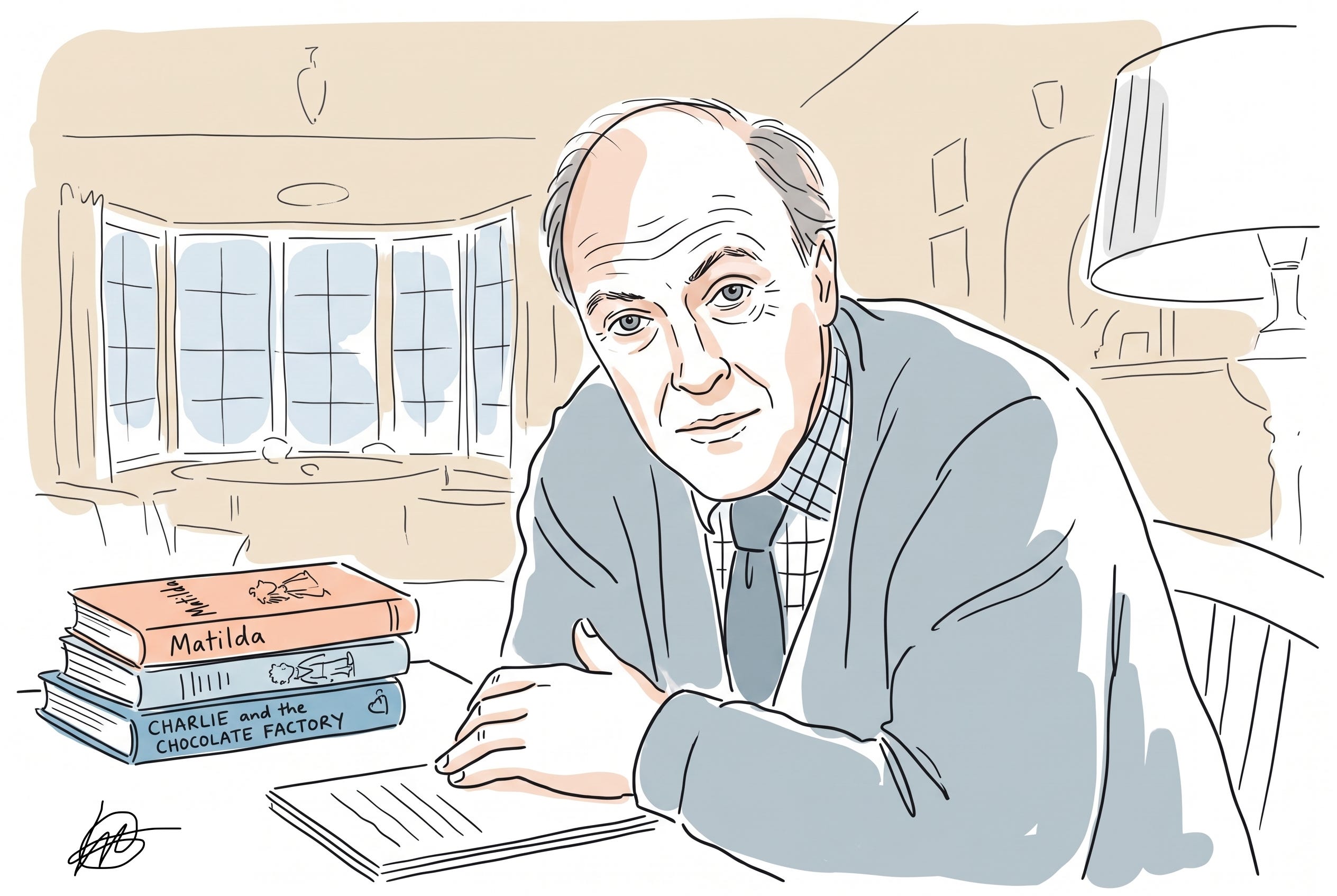
I went into Giant braced for a hit job, and I was wrong about that. Mark Rosenblatt does not put Roald Dahl in the dock and read out the charges against him. He gives him wit, a beautiful house in the country, a fiancée who adores him, and a new children’s book about to ship... And then he lets Dahl talk. John Lithgow plays him as charming, the kind of man you would want at your table. By the end you understand that the charm and prestige were doing the work the whole time. It was how the cruelty traveled.
Liccy, his fiancée, catches the contradiction before anyone else in the room. You keep telling me the Jews in Israel are violent monsters, she says, and yet you tell me the Jews here are weak. She cannot make the two fit together. She is not meant to. The Jew who is too powerful and the Jew who is too cowardly are the same invented Jew, convicted in both directions at once. The charges against him have never needed to agree with one another.
Then there is Tom, Dahl’s British publisher, who is Jewish and wants no part of any of it. “I’m British!” he proclaims. This has nothing to do with me. Yes, I was rolling my eyes too. Later he exclaimed that when his people do something good he feels a flicker of pride, or maybe not pride, maybe just relief at not having to be ashamed for once. When they do something bad, he is ashamed. It is the diaspora bargain, the hope that enough distance from Israel will buy you a pass. It does not. Dahl turns on him anyway and calls him a house Jew. A house Jew? The man who worked hardest to be left out of it gets the ugliest name in the room.
Dahl saves a stranger argument for Jessie Stone, the executive his American publisher sent to manage him. His real quarrel, he tells her, is with Ashkenazi Jews like her. Europeans, with no claim to the Middle East, unlike the “Arab Jews and the Ethiopian Jews.” The flattery is a weapon. It makes some Jews native so the rest can be called foreign. I hear the identical argument now, usually from people who have never read a line of Dahl. The Israeli becomes the white colonizer and the Mizrahi the real thing, and none of it is meant to honor anyone. It is a way to decide which Jews are allowed to belong where they already live. Dahl got there in 1983. The sorting is a pose, and it does not survive the afternoon. By the end he stops pretending any of them are the real ones. He hates all of us.
The play is funniest right before it is at its worst. Stone presses Dahl on Israel fighting a defensive war and asks what Britain would do if its own cities were bombed. We would never be as barbaric as you are to the Palestinians, he says. She gives him two words back. Dresden. Nagasaki.
Later, cornered, he turns to his cook and asks whether she would ever visit Israel, whether she would boycott an Israeli avocado. Does the avocado know that it’s Israeli, she asks, and the house laughed. The laugh matters. The whole logic of the boycott comes apart the moment a real piece of fruit is in your hand.
What lifts Giant above a period piece is that Dahl wrote the ending himself, in life, and Rosenblatt understood that.
In the summer of 1983 Dahl reviewed a book about Israel’s invasion of Lebanon for the Literary Review. No people in history, he wrote, had ever flipped so fast from victims to barbarous murderers. He compared the Jewish state to Nazi Germany. America, he warned, was run by great Jewish financial institutions. The defense he reached for was the one we still hear. He was not antisemitic. He was just anti-Israel.
He could not hold it. That same year he told the New Statesman there was a trait in the Jewish character that provokes animosity, and that even a stinker like Hitler did not pick on them for no reason. In 1990, a few months before he died, he abandoned the distinction altogether. I’m certainly anti-Israeli, he said, and I’ve become antisemitic.
Seven years. That is how long it took a man who swore he only hated the state to confess that he had come to hate the people. Giant takes those seven years and runs them at conversational speed across one afternoon. The hatred of Israel and the hatred of Jews do not sit in separate rooms inside this man. One is the front door. The other is everything waiting behind it.
At the end Dahl is on the phone with a journalist, narrating his own descent and getting louder, and his cook grabs her coat and leaves the house. I understood why. She is an ordinary person who walked into something too big to hold, and walking out was the only sane thing left to do.
I saw the play this spring. Most of Dahl’s lines I had heard before, from people I used to count as friends. Non-Jews who have spent the last two years making his arguments about Israel almost word for word. When the lights came up, everyone else got to leave it in 1983. I walked out into it.
Giant is at the Music Box Theatre on Broadway through June 28, 2026. Get tickets here.
🙏 A brilliant illustration of how insidious antisemitism is. And how hideous it is to listen to this sickness played back - hatred being justified against an entire people 😔🥺 I’m sorry Hen.
Thank you Hen! It was good to read about a children’s author whose books I once loved and read with delight to my own children. I understand your last sentence. It is something casting a pall over all you do, you wake up with it and close your eyes at the end of the day with it. It feels like a living nightmare.