
Before We Knew Her Name
What happens when tragedies become talking points?

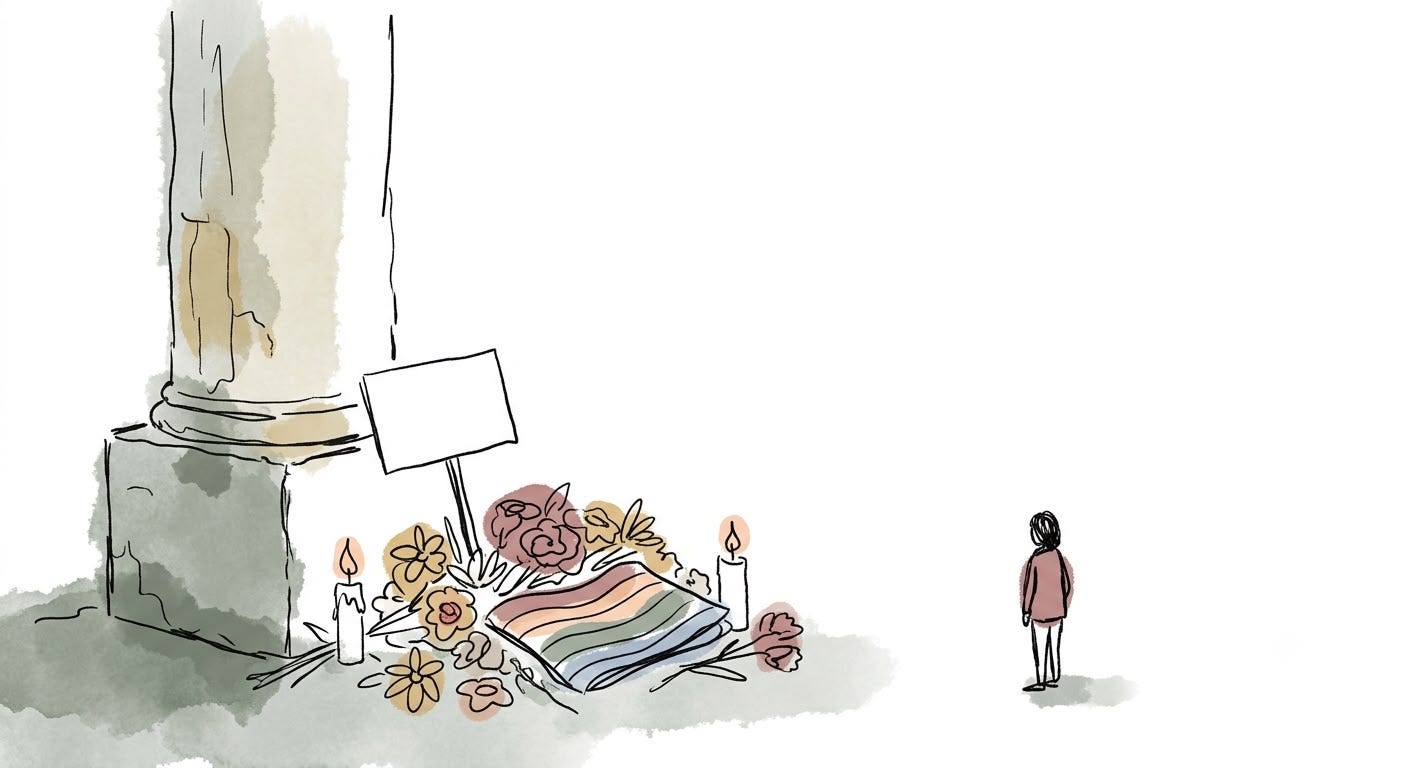
A woman was killed in Berlin’s Tiergarten Park on Saturday night. I still don’t know her name.
I know a great deal about the man who killed her. He flew to Lebanon in 2025 trying to reach Syria and join ISIS. A military court there sentenced him to three months. A German court found he had posted Islamic State propaganda to his Instagram account. Berlin prosecutors requested in May that he stay in custody and were told no. All of that information was repeated endlessly in post after post.
She is “a woman.” The other twenty-nine are “injured, several critically.” A man named Abdul drove a white van down a path a few hundred meters from the Brandenburg Gate, where the closing party of Christopher Street Day was still going on. He drove into a crowd of people walking home from the largest queer celebration in Germany, crashed into a tree, and stabbed several people. Then he ran away.
By Sunday afternoon, before anyone knew who she was, the argument about what her murder “proved” was raging.
Support for the murderer
Al Jazeera English put the story on its Facebook page on Saturday night. Eighteen hours later, the post had collected around 9,700 reactions. Roughly 3,200 of them were the laughing emoji. About a thousand were sad ones.
The comments didn’t hide their contempt for the murdered woman. Just one died!? Salute. Salute to the person who did it. A message from God. One man asked whether the car was all right. Another wrote that God had used the driver to put a stop to the devil’s work, and 112 people agreed with him.
A comment section is not a country. I have spent years telling Jewish audiences that the ugly rhetoric online is not the same as a poll of public opinion. I am not dropping that standard the moment it would be convenient. Nobody in that thread drove the van into the crowd. I’m sure there were Muslims across Europe who spent the weekend the way I did, sick about it.
What is worth noticing is that none of it was hidden. Those were profiles with faces and names attached, sitting under a major broadcaster’s own post for most of a day, laughing at a dead woman in a park. Not one of them thought they needed a burner account to do it.
Condemnation of a community
By Sunday afternoon, a second argument had taken over my feed. It sounded like: “This is what Muslims do, for the five hundredth time, and everyone too well-mannered to say so is complicit.” This message travels on social media, which promotes people who claim to “speak forbidden truths.” You don’t need to ignore the attacker’s ideology, past crimes, or connection to ISIS. But blaming an entire population for an individual’s actions is still wrong.
It is also no use to me, and I say that as the grandson of people who lived their whole lives among Muslims in Baghdad and Djerba until they were driven out. A man who kills a woman at Pride in the name of the Islamic State is not standing in for an entire population. He is a specific man with a specific record. His crime was his own. It speaks for itself.
What was already known
Berlin prosecutors laid it out on Sunday. In 2025, Abdul Ballout traveled to Lebanon intending to cross into Syria and join ISIS, where he made contact with people he believed were members of the group. Lebanese authorities arrested him and a military court sentenced him to three months for offenses including incitement. He returned to Germany and was arrested on arrival. A German court found that he had published Islamic State propaganda on his Instagram account in 2024. In May 2026, he was sentenced to twenty-two months.
Prosecutors asked for a longer sentence, without probation, and for the arrest warrant against him to stand. They were overruled. The court released him under probation supervision and deferred its final decision on suspending the sentence by six months. On July 3, police searched his address over a suspected weapons offense.
Twenty-two days later, he ran a van through a crowd celebrating Pride.
None of that requires a theory about 1.9 billion people. It requires an answer from a German court about what it believed it was doing in May. Germany has not offered one.
New York, Thursday
Two days before Berlin, on Tisha B’Av, a man walked up behind a 57-year-old Asian man near West 84th Street and Central Park West and stabbed him in the back with no warning. He kept walking. Witnesses say he passed a synagogue shouting “Justice for Islam” and “Allahu Akbar.” Four blocks on, he found Moshe Grunhaus, a 50-year-old Jewish man who had just stepped out of a synagogue in a kippah, and drove a screwdriver into his chest. Both men are expected to live. Raul Morales, 51, was arrested within the hour and charged with hate crimes.
The attack came just days after the mayor, Zohran Mamdani, released a dramatic video on X that was viewed millions of times. In it, he claimed that Prime Minister Netanyahu is a war criminal and that the war Hamas started is a genocide. By the time he got around to mentioning that he doesn’t have the power to arrest him, his supporters had gotten the message.
Today, with zero mention of the double stabbing, one of Mamdani’s supporters said explicitly what she understood from his video. She took to TikTok to explain that while Mamdani can’t arrest Netanyahu, he was signalling that New Yorkers should make his visit “as uncomfortable as possible.” And they shouldn’t stop there. New Yorkers should be protesting Israeli businesses and politicians, too, she said. Mamdani, for his part, should not let the NYPD protect anyone associated with Israel from violence.

The mayor said he can’t arrest Netanyahu. His followers heard that he won’t stop them from harming Israelis. His allies spent the weekend explaining why he’s not responsible. And two men are recovering after being stabbed on the street.
I’ve seen many of the same people now denying Mayor Mamdani bears any responsibility be more than willing to accept that politicians’ rhetoric can incite violence when that rhetoric comes from, say, President Trump. I am not drawing a direct parallel. I am simply asking for people who claim to oppose antisemitism to apply their analysis consistently.
And from Berlin to Manhattan, I am calling on every leader and every authority to take this seriously. You have freedom of speech, but we don’t have the freedom from the violence your words incite.
What they have in common
The thing Berlin and West 84th Street share isn’t just the authorities deflecting responsibility. It’s the speed with which everyone jumped past the people who were actually hurt.
And as we see this polarized response to violence repeat itself in cities across the world, I have begun to think that the two phenomena are more connected than I’d assumed.
Authorities like Zohran Mamdani are to blame for inciting violence by spreading outrageous claims and focusing disproportionately on Israel. Berlin authorities are to blame for releasing a man whose record seems, in retrospect, like a clear indication he was still a threat. And the attackers are to blame for maiming and murdering innocent people.
But politicians are also a reflection of the public. And the public’s response to tragedy, lately, and seemingly from all sides, has been to polarize before we mourn.
I am not saying we should ignore the identities of murderers or their victims. I am not letting any leader off the hook for failing to do their job. And I’m not saying that it is “too soon” to broach these discussions. I am saying that the timbre of the conversations, as they are amplified on social media, is transforming murder from a tragedy into a talking point. The goal cannot be to win an argument. It must be to stop the next attack.
Being gay and Jewish means finding out, from two directions at once, what your death is worth as an argument. One side would file it under Islamism and move on. The other would check first whether mourning you complicated anything about Gaza. Since October 7th, I have received both hourly death threats and daily derision for “playing the victim card.” I am living through what it means for our lives and protection to become political footballs. I don’t wish it on anyone.
Germany owes the public an answer about why a man its own court convicted of Islamic State propaganda in May was walking free with access to a van in July, and the prosecutors who asked for him to stay in custody deserve to have that question put loudly, in the Bundestag, by people with subpoena power. New York owes its Jews an apology for ignoring their valid fears until it was too late.
And when Berlin releases her name, I want to see it travel as fast as her murderer’s did. May her memory be a blessing.
Thank you Hen. What stood out for me, and what really resonates, is how quickly attention moved away from the woman who lost her life.
I’ve often wondered whether this is, in part, a psychological defence. Perhaps our fascination with the perpetrator says less about them than it does about our own need to believe the world is understandable, and therefore safer. If we can make sense of the person responsible, we create the comforting illusion that we are somehow less at risk ourselves.
My sister Lolly was murdered in 1995. Thirty-one years later, people are still far more likely to ask me whether the person responsible was ever caught than to ask me about our Lolly - who she was, how she lived, what she loved or what she meant to those of us who knew and loved her so deeply. She was 22 years old.
I feel so much for this woman’s loved ones, whose lives are forever changed in ways that we cannot even begin to know.
With warmth, Debbie 🌸
I would like to see more of the 1.9 billion Muslims speak out about the continual attacks by people acting in their name.